
Ingredients & science
Gummies or capsules: what really differs, and how to choose
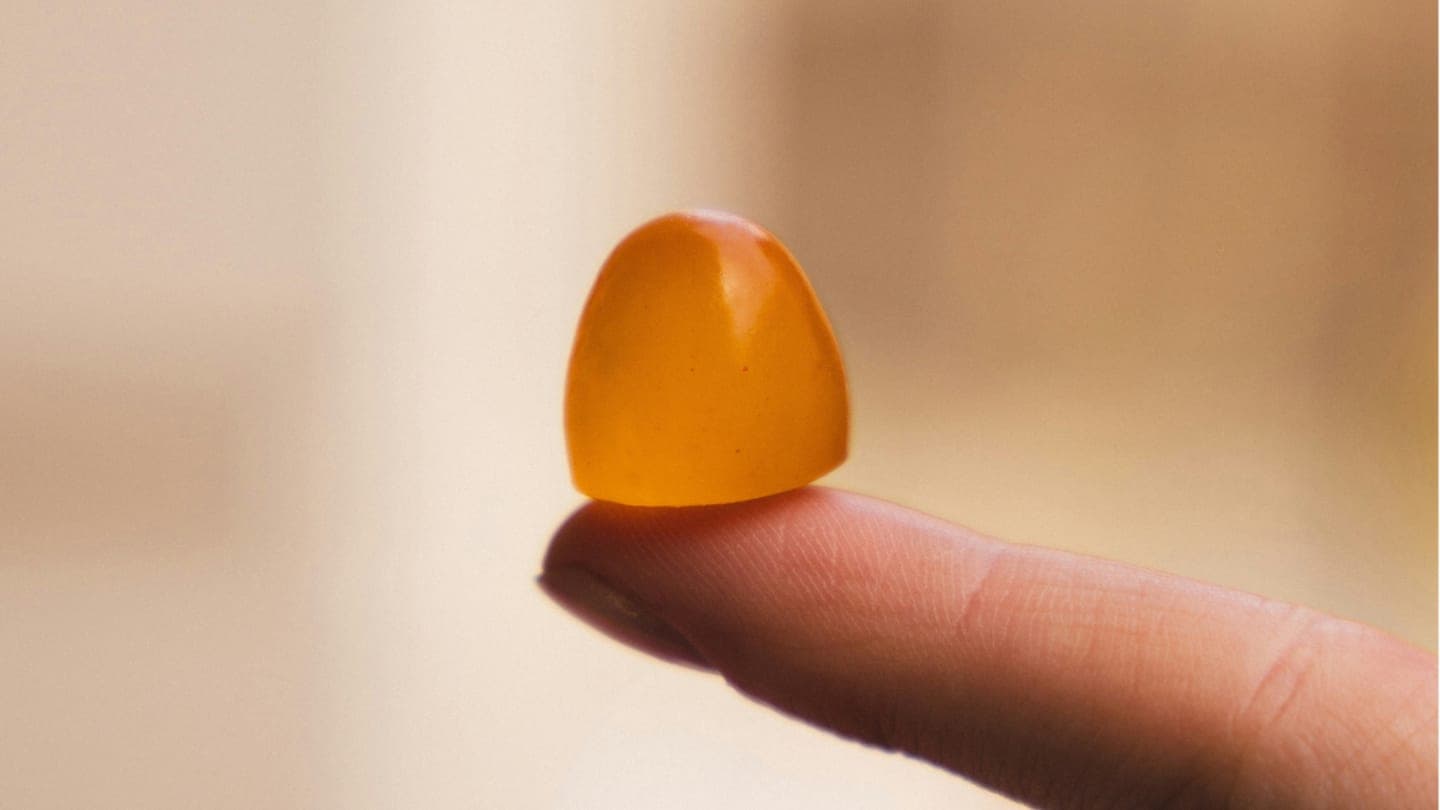
The answer fits in two sentences. The best format is the one you will take every day — a supplement forgotten in a cupboard has zero efficacy, whatever its formula. But not every active can go into a gummy: space is tight, and some substances are unstable there. Here is what genuinely separates the two formats, and how to read a label so you aren't paying for an image.
The physical constraint: available space
This is the point most comparisons skip. A capsule commonly holds 500 to 800 mg of active powder. A gummy weighs 2 to 4 g in total, but most of that is the base — sugar or sweetener, pectin or gelatine, flavours, colours. In practice 100 to 500 mg is left for actives.
Direct consequence: an active whose studied dose is 500 mg fits easily in a capsule, and takes two to four gummies. That is why some products state « 2 gummies a day » — not marketing, geometry.
Conversely, an active effective at low dose — vitamins, minerals, melatonin at 1 mg — fits perfectly in a gummy with no compromise.
What travels badly in a gummy
- High doses: magnesium at 300 mg, collagen at several grams, omega-3 in useful amounts. Impossible without multiplying units.
- Very bitter actives: reishi, some plant extracts. Masking the taste means sweetening more.
- Heat- or moisture-sensitive substances: some vitamins and probiotics tolerate the manufacturing process and storage poorly.
- Oils, hard to incorporate into a gelled matrix.
The sugar question, in figures
A gummy commonly contains 1 to 3 g of sugar. At two a day, that is 2 to 6 g — half to one and a half sugar cubes. Against daily intake guidance it is marginal; but it is real, and worth stating rather than glossing over.
Sugar-free versions use sweeteners, most often polyols such as maltitol or xylitol. Mind the laxative effect beyond a few grams, and remember that xylitol is toxic to dogs — rarely mentioned, and serious if the jar sits within reach.
For people with diabetes, the glycaemic impact of two gummies stays small, but it counts within the day's total.
Gelatine or pectin
Gelatine is animal-derived — porcine or bovine — which rules those gummies out of vegetarian, vegan, halal and kosher diets. Pectin, plant-derived, settles that; it gives a slightly less elastic texture, a matter of preference rather than quality.
On capsules, the same question arises: gelatine or HPMC (plant cellulose). A plant capsule usually carries the mention vegan or HPMC.
Adherence: the decisive gummy advantage
This is their real strength, and it isn't trivial. A supplement works if taken regularly for weeks — four to eight for most background actives. Adherence research shows that pleasantness of intake weighs heavily on consistency, particularly for people who struggle to swallow capsules.
A perfectly dosed active taken three days out of seven does less than a properly dosed one taken daily. That is the format's central argument, and it holds.
Stability and storage
Capsules protect their contents better: the shell shields from light and oxygen. Gummies are more sensitive to heat — they stick or melt above 25°C — and to humidity. Keep them away from light, dry, and close the jar properly.
Their shelf life after opening is also shorter. An opened jar is for the coming weeks, not the coming year.
How to read a label, whatever the format
Three checks apply to both:
- The active dose per daily serving, not per unit. A product stating « 500 mg » per gummy with a daily serving of two isn't offering the same as one stating 500 mg for the full serving.
- No « proprietary blend »: if the amount of each active isn't detailed, it is generally because they are low.
- The form of the active: bisglycinate or oxide for magnesium, standardised extract or plain powder for a plant. Two products stating the same weight may have nothing in common.
Claims are governed by Regulation (EC) No 1924/2006: only those in the EU register may be used. A formula promising to « treat » or « cure » falls outside the legal framework for food supplements, whatever its format.
How to choose, concretely
- Take a capsule if the active needs a high dose — collagen, full-dose magnesium, omega-3 — or if you want the best dose-per-euro.
- Take a gummy if you swallow capsules badly, if consistency is your difficulty, or for actives effective at low dose.
- Take a powder for doses of several grams: the only format that allows them without swallowing ten units.
Precautions
Gummies carry two specific risks. First their appeal to children, who may take them for sweets: store them out of reach, in a closed container — the most important precaution in this article. Second overdosing, easier when the taste is pleasant: respect the stated daily serving, especially for fat-soluble vitamins (A, D, E, K), which accumulate.
A food supplement, whatever its format, does not replace a varied, balanced diet or a healthy lifestyle, and it neither prevents, treats nor cures any disease. If on treatment, pregnant or breastfeeding, seek advice from a healthcare professional. In France, adverse effects can be reported to ANSES nutrivigilance.
At BIEN
We chose the gummy format for CALM, FOCUS and POWER, because those formulas rest on actives effective at moderate doses and because consistency is decisive there. And we chose powder for MUSHGLOW, because collagen is dosed in grams: putting it in gummies would have meant swallowing about ten.
The exact amount of each active appears on the Ingredients page — the first figure to compare, with us as with anyone.
Frequently asked questions
Are gummies less effective than capsules?
Not inherently: at equal doses of the same active, efficacy is comparable. The difference is available space — a gummy holds 100 to 500 mg of actives against 500 to 800 mg for a capsule — so it bears on actives needing high doses.
How much sugar is in a gummy?
Commonly 1 to 3 g per unit, so 2 to 6 g for a two-gummy serving. Marginal across a day, but real. Sugar-free versions use polyols, which can be laxative beyond a few grams.
Are gummies suitable for vegetarians?
Only pectin-based ones. Gelatine gummies are animal-derived, porcine or bovine. The same question applies to capsules: gelatine or plant HPMC.
Can you give gummies to children?
Only products formulated for them, and on a healthcare professional's advice. Above all, store every supplement out of reach: their resemblance to sweets is a well-documented risk of accidental ingestion.
How should gummies be stored?
Away from light, dry, below 25°C, jar tightly closed. They tolerate heat and humidity less well than capsules, and should be consumed within weeks of opening.
What should you check first on a label?
The active dose for the full daily serving, the absence of a « proprietary blend », and the form of the active — bisglycinate or oxide, standardised extract or plain powder. Two products stating the same weight may have nothing in common.
Going further
Our natural chewable supplements: science-based dosages, no added sugar, no artificial additives and vegan.