
Ingredients & science
Adaptogenic mushrooms: benefits and complete guide
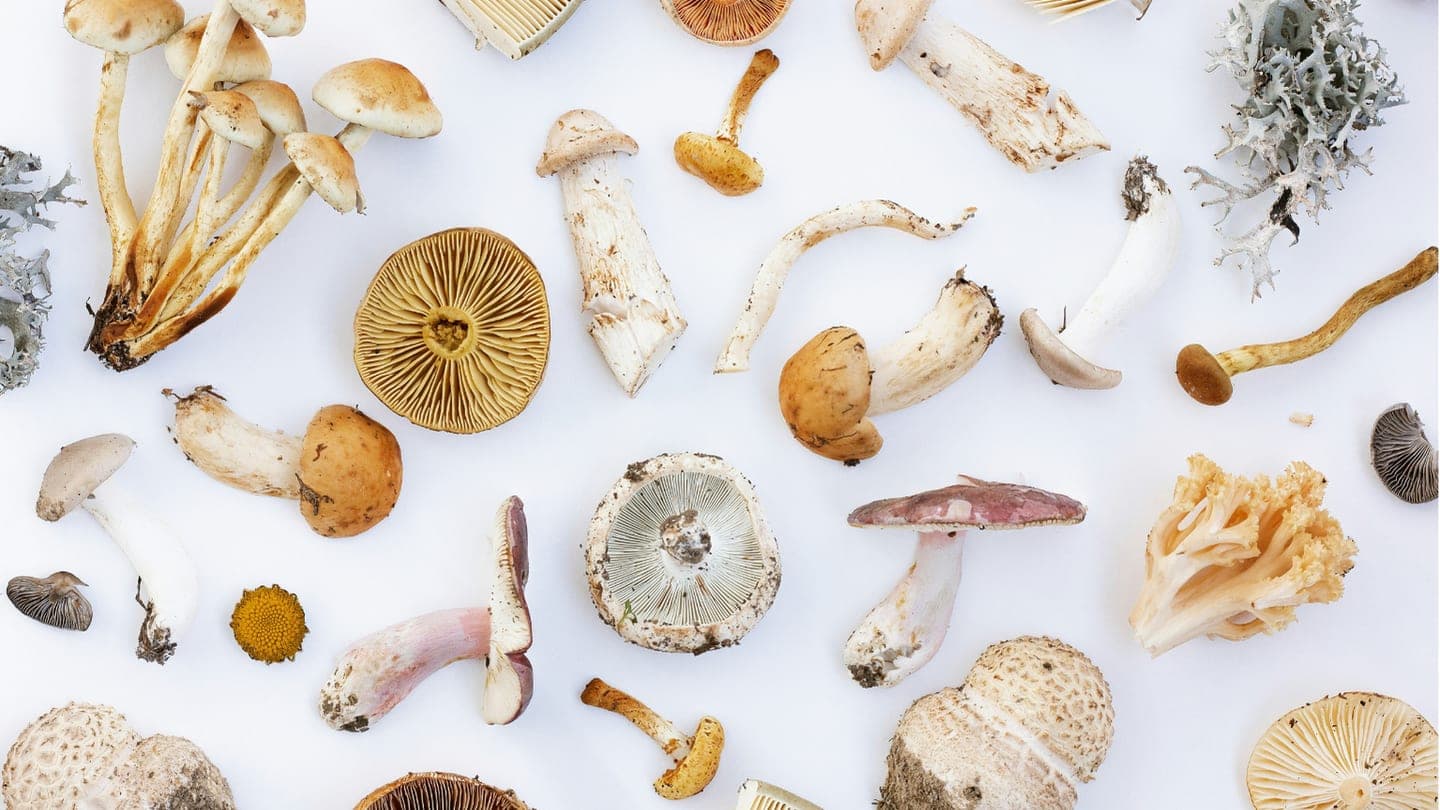
Adaptogenic mushrooms — lion's mane, reishi, cordyceps, chaga — are so-called functional mushrooms: you don't eat them for their taste but for the compounds they contain. Each has its own ground, and confusing them is the most common mistake. This guide explains what each one does, how to recognise a quality extract, at what dose and for how long, and where honest claims stop.
What an adaptogenic mushroom is
An adaptogen is a natural substance that helps the body cope with demands, favouring a return to balance rather than stimulating. Applied to mushrooms, the term covers a handful of species that aren't culinary, used for centuries in Asia and consumed today as extracts.
Their particularity lies in their cell wall, rich in beta-glucans — polysaccharides under research, notably for immunity. Extract quality is judged on beta-glucan content far more than on the weight printed on the label.
Lion's mane: memory and mental clarity
Hericium erinaceus, or lion's mane, is the most studied on the cognitive side. The work indexed on PubMed looks at its compounds, hericenones and erinacines, over eight to sixteen week protocols.
It's the one associated with focus and mental clarity. Take it in the morning or early afternoon; it has no caffeine-like stimulant effect. Details and doses in our page on Lion's Mane.
Reishi: relaxation and sleep
Ganoderma lucidum is called the « mushroom of immortality » in Chinese tradition. Bitter and impossible to cook with, it's taken as an extract or infusion, rather in the evening.
It's the end-of-day mushroom: associated with calming and preparing for sleep, often alongside a plant such as ashwagandha. It's part of our CALM formula.
Cordyceps: endurance and breath
Cordyceps sinensis, today grown as Cordyceps militaris, is traditionally associated with endurance and tissue oxygenation. It's the most studied of the four on physical performance.
Take it in the morning or before exercise, never in the evening. It's the main active in our POWER gummies, and is covered in our comparison of Reishi, Cordyceps and Chaga.
Chaga: the antioxidant
Inonotus obliquus grows on birches in boreal forests. It has a remarkable antioxidant compound content, which explains its place in beauty and vitality formulas — including our MUSHGLOW supermix.
One rarely mentioned caveat: chaga is high in oxalates, which makes it unsuitable for people with a history of kidney stones.
How to recognise a quality extract
This is where most of it is decided, and where products differ most. Four criteria settle the question:
- The part used: the fruiting body rather than grain-grown mycelium, which is far less concentrated in beta-glucans.
- The beta-glucan content, shown as a percentage. If it isn't stated, that's rarely a good sign.
- The extraction ratio (10:1, 15:1…): it tells you how much raw material went into the extract.
- Origin and testing: mushrooms concentrate heavy metals from their substrate, hence the importance of controls. Ours are documented on our compliance page.
Be wary of « mushroom powder » with no further detail: it covers both a concentrated extract and ground substrate containing very little active material.
Dose, duration, timing
Study protocols mostly involve daily intake over eight to twelve weeks. In practice, a one-month course is the threshold below which nothing perceptible generally happens.
Timing matters: lion's mane and cordyceps in the morning, reishi in the evening, chaga any time. And regularity beats dose — a modest daily intake does more than a large dose twice a week.
What regulation allows you to claim
Health claims are governed by EU regulation (EC) No 1924/2006, and those relating to plants and mushrooms remain pending evaluation by EFSA — searchable in the EU register of claims.
In practice: a food supplement cannot claim any property of preventing, treating or curing. Honest wording speaks of contributing to the normal function of the body. Any brand promising to « cure » anything is in breach.
Precautions
Adaptogenic mushrooms are not advised during pregnancy or breastfeeding. Reishi may interact with anticoagulant and antihypertensive treatments; chaga is not advised with a history of kidney stones or alongside anticoagulants. With ongoing treatment or an autoimmune condition, seek advice from a healthcare professional.
They replace neither a varied, balanced diet, nor a healthy lifestyle, nor medical advice.
Which one to start with
Start from the need: mental clarity and focus → lion's mane; sleep and nervous tension → reishi; physical energy and endurance → cordyceps; skin and vitality → chaga, paired with collagen.
If you're hesitating, the BIEN quiz points you in a minute, and the shop shows the four formulas with their full composition.
Frequently asked questions
Which adaptogenic mushroom is best?
There isn't one: each has its ground. Lion's mane for mental clarity, reishi for calm and sleep, cordyceps for endurance, chaga for its antioxidant contribution. The right choice starts from the need.
Can you take several mushrooms together?
Yes, that's the logic of combined formulas. Just avoid stacking several products containing the same active, so as not to exceed daily doses.
How long should a course last?
One to three months, followed by a break. Below a month, nothing perceptible usually happens: studies run eight to twelve weeks.
How do you spot a good extract?
Fruiting body rather than grain-grown mycelium, stated beta-glucan content, published extraction ratio, and available heavy-metal testing. The absence of that information is itself a signal.
Are adaptogenic mushrooms dangerous?
Not at usual doses, but they aren't harmless: not advised during pregnancy and breastfeeding, possible interactions with anticoagulants for reishi and chaga, and caution with autoimmune conditions.
When in the day should you take them?
Lion's mane and cordyceps in the morning, reishi in the evening, chaga any time. Regularity matters more than dose.
Going further
Our natural chewable supplements: science-based dosages, no added sugar, no artificial additives and vegan.