
Ingredients & science
Reishi, Cordyceps, Chaga: what each mushroom is actually for
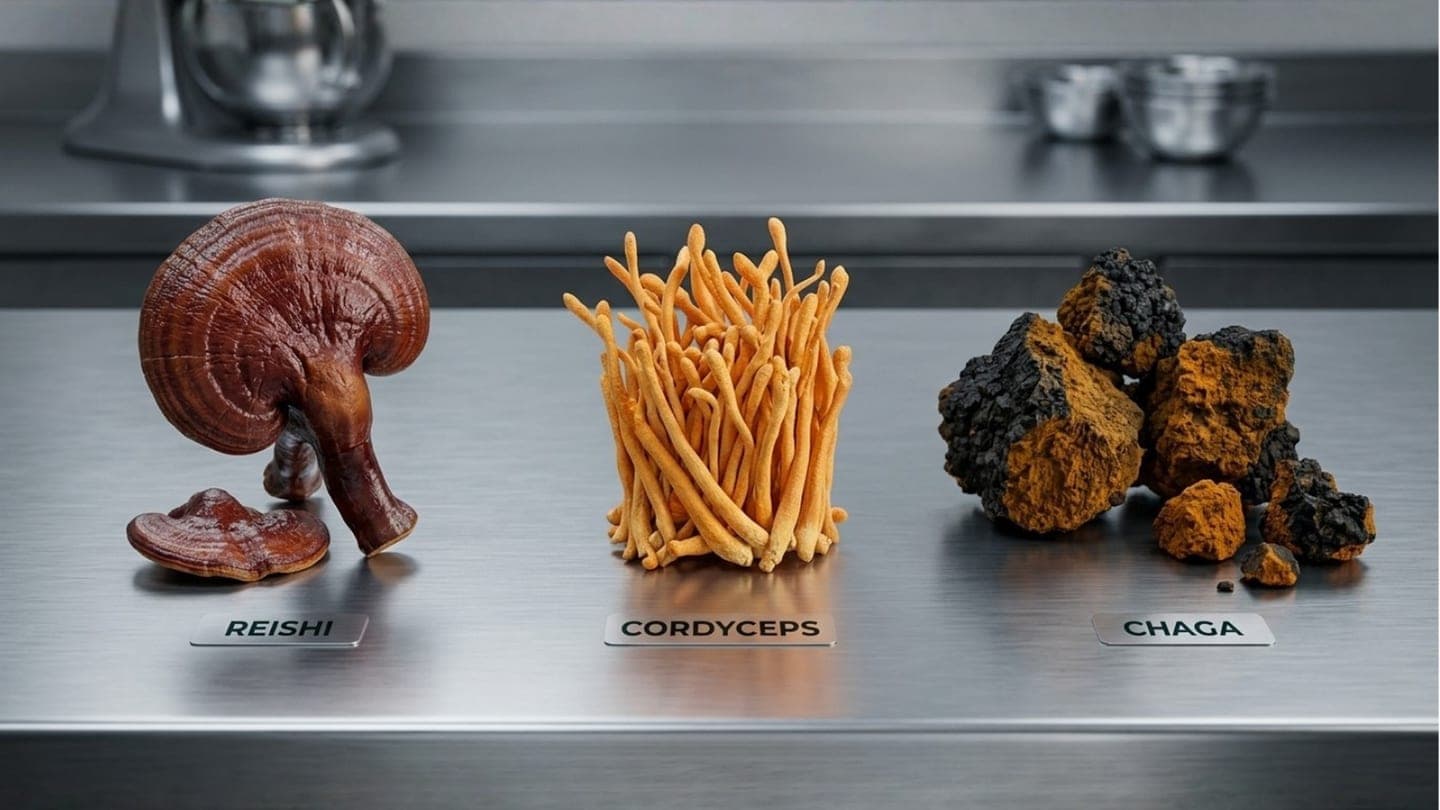
Short answer: these three mushrooms don't substitute for one another. Reishi is taken in the evening, for winding down; cordyceps in the morning, for endurance; chaga for its antioxidant profile. Confusing them means taking the wrong product at the wrong time — the commonest beginner's mistake. Here is what each does, what the studies really show, and how to combine them without stacking capsules.
What they share
All three are functional mushrooms: you don't eat them for flavour but for their compounds. All contain beta-glucans, the polysaccharides characteristic of fungal cell walls, studied for how they interact with the immune system.
All three need extraction to be usable: the chitin in the wall resists human digestion, and a mushroom merely dried and milled delivers a fraction of its compounds. That is why « mushroom powder » with no mention of extraction isn't worth the same as an extract.
Reishi: the evening mushroom
Ganoderma lucidum, known as lingzhi in China, where it has been used for over two thousand years. Too tough and too bitter to cook, it is taken as a decoction or an extract.
Its distinctive compounds are triterpenes, responsible for the bitterness, alongside beta-glucans. Work indexed on PubMed looks mainly at sleep quality, fatigue and immune markers. Human trials remain few and small.
In practice it is the end-of-day mushroom: it doesn't knock you out like a sleeping pill, it accompanies the wind-down. A dose in the evening, an hour or two before bed, makes more sense than a morning one.
Cordyceps: the effort mushroom
Cordyceps militaris accounts for essentially everything sold today, grown on substrate. The wild species Cordyceps sinensis, which parasitises caterpillars on the Tibetan plateau, is exceedingly rare and priced accordingly: a cheap product claiming it is mislabelled.
Its reference compound is cordycepin. Studies, likewise on PubMed, look at oxygen uptake during exercise and exercise tolerance, with modest results seen mostly in untrained or older subjects. In trained athletes, the effect isn't demonstrated.
So it is the morning or pre-session mushroom. It contains no caffeine and causes no jitters: it doesn't replace coffee, it works on another register — oxygen use, not alertness.
Chaga: the antioxidant mushroom
Inonotus obliquus grows as a black outgrowth on birches in cold forests. Its colour comes from melanin, and it concentrates polyphenols and triterpenes giving it one of the highest antioxidant profiles in the fungal kingdom — measured in the laboratory, which says nothing definitive about its effect in the body.
That is the gap to hold on to: human data on chaga are the thinnest of the three. Most work is in vitro or in animals. You may legitimately value it for its composition, not promise clinical effects from it.
One concrete safety point: chaga is rich in oxalates. Cases of kidney injury have been described after high, prolonged intake. It is therefore not advised with a history of kidney stones or with renal impairment, and is better avoided as a high daily dose over the long run.
Which to choose for which goal
- Restless sleep, evening tension, a stressful period: reishi, in the evening. See also our advice on sleeping better naturally.
- Endurance, getting back into activity, flagging during effort: cordyceps, morning or pre-session.
- Antioxidant terrain, skin, cold season: chaga, as a course, without excess.
- Memory and focus: none of the three is the best candidate — that is lion's mane territory.
Should you combine them?
Yes, provided combining isn't stacking. Reishi and cordyceps work at opposite ends of the day: putting them in the same morning capsule cancels the logic of each.
The real risk with eight-mushroom blends lies elsewhere: underdosing. A product announcing eight species in a 500 mg total holds about sixty milligrams of each — far below studied doses. Two properly dosed mushrooms beat eight names on a label.
Doses and duration
Usual markers, for standardised extracts: 1 to 2 g a day of reishi, 1 to 3 g of cordyceps, 1 to 2 g of chaga. Those figures are for mushroom powder; with an 8:1 concentrated extract the amounts divide accordingly, which explains labels stating 250 or 500 mg.
Allow four weeks before expecting to notice anything and eight to twelve to judge. Functional mushrooms work in the background; nobody should promise an effect from the first dose.
How to recognise a serious product
- Fruiting body rather than grain-grown mycelium, the latter supplying mostly substrate starch.
- Stated beta-glucan content, ideally above 25%. « Total polysaccharides » includes starch and inflates the figure.
- Dual extraction, water and alcohol, for reishi and chaga, whose triterpenes are not water-soluble.
- Heavy-metal testing: mushrooms accumulate what their substrate contains, making origin and controls decisive.
Precautions
All three are well tolerated at usual doses, reported side effects being mainly digestive. They are not advised during pregnancy or breastfeeding, for lack of data. Reishi may thin the blood: caution on anticoagulants, and stop two weeks before surgery. Chaga calls for the kidney vigilance noted above, and particular attention in people with diabetes, an effect on blood sugar being described.
No health claim is authorised for these mushrooms in the EU register: under Regulation (EC) No 1924/2006, claims on plants and fungi are « on hold » pending evaluation. A food supplement does not replace a varied, balanced diet or a healthy lifestyle.
When to see a healthcare professional
Fatigue lasting more than a few weeks, unusual breathlessness on exertion, repeated infections or sleep that has been poor for over a month deserve medical advice before any supplementation. Anaemia, vitamin D or B12 deficiency, hypothyroidism, sleep apnoea: these common causes are found through examination and a blood test, and can be corrected. No mushroom substitutes for that.
If you are on treatment — anticoagulant, immunosuppressant, antidiabetic — your doctor's or pharmacist's advice is necessary before adding a fungal extract.
At BIEN
Reishi is in our CALM gummies with ashwagandha and saffron; cordyceps in POWER, geared to energy; chaga in the MUSHGLOW powder, alongside collagen. Every dosage is stated on the Ingredients page.
To find the right starting point, the BIEN quiz guides you in a few questions, between the Serenity and Performance & Vitality collections.
Frequently asked questions
Can you take reishi, cordyceps and chaga together?
Yes, but not at the same time of day: cordyceps in the morning, reishi in the evening, chaga either way. Check the dosages above all — an eight-mushroom blend in 500 mg gives only a fraction of the studied dose of each.
Which one for sleep?
Reishi, one to two hours before bed. It isn't a sleeping pill: it accompanies the evening wind-down rather than inducing sleep.
Does cordyceps replace coffee?
No. It contains no caffeine and acts not on alertness but on oxygen use during effort. Measured effects are modest and seen mostly in untrained people.
Does chaga carry a risk?
It is rich in oxalates, and kidney injury has been described after high, prolonged intake. It is not advised with a history of kidney stones or renal impairment, and shouldn't be taken at high doses long term.
Powder or extract?
Extract, in most cases: mushroom cell walls resist digestion, and merely dried powder releases a fraction of its compounds. Look for dual water-and-alcohol extraction for reishi and chaga.
How long before an effect shows?
Four weeks minimum, eight to twelve to judge honestly. These are background actives, not fast-acting stimulants.
Going further
Our natural chewable supplements: science-based dosages, no added sugar, no artificial additives and vegan.